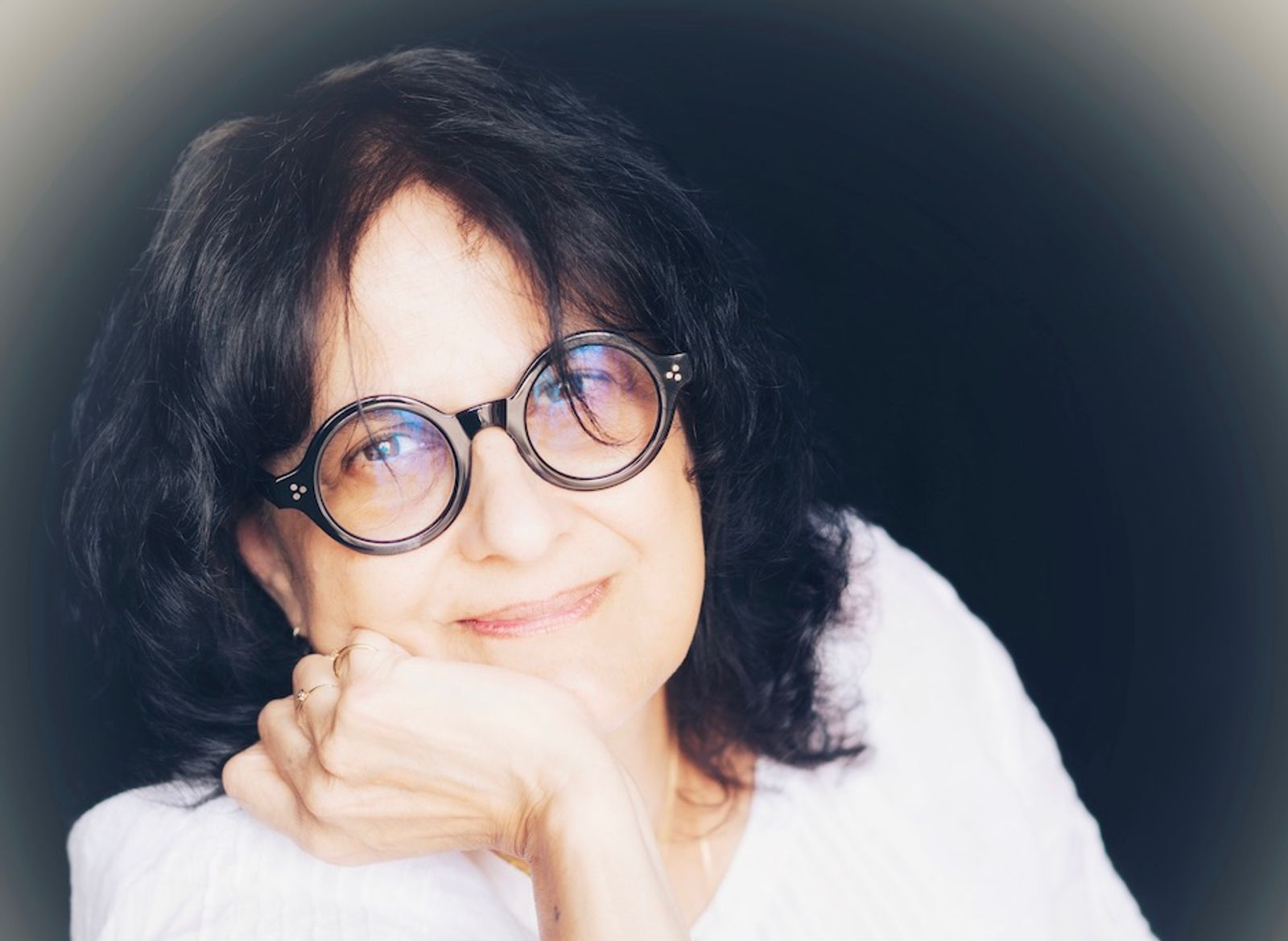
Photograph by Cathy Knight-Waite, 2024
Installation Artist · Filmmaker · Sound Designer
Sadia Sadia
Dr Sadia Sadia is an installation artist, filmmaker, sound designer and writer whose work spans installation, moving image and spatial sound. She is also an award-winning record producer
Biography
Dr Sadia Sadia is an installation artist, film maker, sound designer and practice-based researcher working across a wide variety of media. She is also an award-winning record producer and writer.
Her research focuses on neuroaesthetics and the methodologies surrounding the construction of profound emotional experience in surrounded space and aesthetic environments. She began her career by becoming among the first women in the world to be signed to a major label as a record producer.
Her work as an installation artist and film maker is held in permanent museum collections and has been exhibited and screened worldwide.
Sadia holds an M.Sc. in Political Science and Economics from the University of London, an M.A. in Design Studies from the University of the Arts (London), and a Ph.D. in Fine Art from RMIT University in Melbourne, Australia.
She is a Senior Industry Fellow, College of Design and Social Context (SoA) at RMIT University, a QS University Global Top Twenty in Art and Design (2026), and a Fellow of the Royal Society of Arts. Since 2013, she has been based at The Light Room, Real World Studios in Wiltshire, UK.
[01]
Music
Sadia started her first production company at the age of eighteen. She subsequently became among the first women in the world to be signed to a major record label as a record producer, to Capitol-EMI by record executive David Munns OBE.
Much of her early production career was spent working with Canadian guitarist and songwriter David Wilcox. She produced Out of the Woods [1977], My Eyes Keep Me in Trouble [1983], Bad Reputation[1984], Breakfast at the Circus [1987] and The Natural Edge [1989], and co-wrote many of the songs appearing on these records. The recordings subsequently formed the basis of several compilations, including The Best of David Wilcox [1985], Over Sixty Minutes With [1987], Greatest Hits Too [1997] and Collected Works 1977–1993 [1993]. Her work with Wilcox received multiple gold and platinum Music Canada album certifications.
After relocating to the United Kingdom, Sadia became the first female member of the British Record Producers Guild [BRPG] [now the Music Producers Guild], then under the presidency of Sir George Martin, joining when the Guild had only eleven members. She later served for several years on its Board of Directors under chairman Sir Robin Millar CBE.
In the 1990s, Sadia produced tracks for The Fixx and was a founding member, with Stephen W Tayler, of the world-fusion project Equa. Signed to PolyGram Australia, Equa's eponymous album was nominated for an ARIA Award in 1997. The Sydney Dance Company subsequently incorporated two works choreographed by Wakako Asano to music by Equa into its repertoire: Unwitting Sight (1998) and Cradle Song (2001), under artistic director Graeme Murphy.
In 1996, Sadia produced Respect for the Trades Union Congress campaign Respect: Unite Against Racism, bringing together dozens of international recording artists at Metropolis Studios, London. The project received national media coverage and recognition in the House of Commons through an Early Day Motion, tabled on 4 July 1996.
Sadia's recording catalogue has been used extensively in film, television and documentary productions, with screen credits including Cocktail, The Great Outdoors and The Corporation. Equa's music has also been used in Australian television, including ABC's Behind the News. In 2026, Sadia's original 1977 production of “Do the Bearcat” by David Wilcox was used in Petro-Canada's Winter Games campaign, created by McCann Canada.
Sadia also founded and ran the independent label Chimera Records, producing its releases, as a place to let unusual work exist on its own terms. After a long period of dormancy, the label and its catalogue are now being revisited.
In 2015, Sadia executive-produced Stephen W Tayler's Ostinato CD/DVD, followed in 2019 by his audiovisual performance Da Capo at Real World Studios and the Da Capo CD/DVD release through Burning Shed/Cherry Red in 2021. Alongside her own practice, Sadia occasionally provides production coordination and project management for selected Chimera Arts projects.
[02]
Films & Installations
In 2004, Sadia’s single-channel installation The Memory of Water [Part I] [2004] was acquired for the permanent collection of the Australian Centre for the Moving Image [ACMI], one of the world’s leading and most visited museums of screen culture [ACMI Accession B1006598]. The work was presented in ACMI’s major exhibition Proof: The Act of Seeing With One's Own Eyes [2004–05], accompanied by the publication of the exhibition book Proof, and was screened across the internal and external screens at Melbourne’s Federation Square. The Memory of Water received prominent contemporary press coverage, including Lawrie Zion’s “Screening the Truth” in The Australian, Arts/Film, 8 December 2004.
Sadia also produced, edited and scored the short film The Noon Gun, with her creative partner Stephen W Tayler, with the score credited to Equa. The film draws on footage shot in Afghanistan in 1971, including images of the monumental Buddhas of Bamiyan, destroyed in 2001. Made with support from the British Council, The Noon Gun premiered at the 53rd Melbourne International Film Festival. It subsequently screened internationally at festivals and institutions including the National Museum of Photography, Film and Television, Bradford [now the National Science and media Museum]; Films From the South, Oslo; the Portobello Film Festival, London; the Cleveland Museum of Art; the World Performing Arts Festival, Lahore; and Film Mutations, Zagreb. Shortlisted for the Satyajit Ray Foundation Short Film Competition, extracts were screened at BAFTA in London. The film was also broadcast in Afghanistan by Tolo TV and in Bhutan by Bhutan Broadcasting Service, and in 2009 was presented at the Tricycle Theatre, London, as part of The Great Game: Aspects of Afghanistan. The season received an Olivier Award Nomination for Outstanding Achievement.
In 2005, Sadia directed Howard Jones: 20th Anniversary Concert Live at the Shepherd's Bush Empire, a feature-length concert film documenting Howard's 20th anniversary performance in London. Alongside a professional camera crew, Sadia distributed video cameras among members of the audience, incorporating their perspectives into the film. The resulting 176 hours of footage were edited by Sadia into the final concert film.
Other early moving-image works included The End of the Party: Hyde Park 1969, Iggy, a short film featuring Evelyn “Iggy” Rose, known for her association with Syd Barrett and her appearance on the cover of The Madcap Laughs, and Lit from Within. With Stephen W Tayler and Anthony Stern, Sadia also directed, edited, produced and sound-designed San Francisco Redux No. 1. These works were presented in the curated Le Cinéma d'Avant-Garde programme at La Cinémathèque Française, Paris, in 2008. San Francisco Redux No. 1 subsequently screened at the États Généraux du Film Documentaire in Lussas where it featured in Nicole Brenez’s programme On the Subject of Regrettable Searching — Body to Body, the Filmed Body, and later became the subject of an essay by film critic and theorist Brenez. Later presentations include Breaking Convention at the University of Greenwich in 2019 and the Royal Society of Arts in London in 2022.
In 2009, Sadia was awarded the Studio 18 International Artist Residency at Gertrude Contemporary, Melbourne. Her work there included early iterations of Noise and Ghosts of Noise and the development of Metamorphoses in ‘A’ Minor, a three-channel moving-image installation featuring dancer and choreographer Wakako Asano. Filmed at the Kennedy Miller Mitchell motion-capture soundstage in Sydney with support from Gertrude Contemporary, Kennedy Miller Mitchell and a British Council Australia project grant, the work employs the distortion and manipulation of time, ranging from real time to ultra-slow motion. It was subsequently presented in single-channel form at Sarah Lawrence College's SLC DanceFilm in 2018.
Following a 2013 residency in Cataract Gorge, Tasmania, Sadia completed All Time and Space Fold into the Infinite Present [Cataract Gorge] [2014], a large-scale three-channel moving-image installation with an eight-channel soundfield derived from images and field recordings made in the Gorge. The work premiered in a solo exhibition at QVMAG in Launceston in January 2014 and was subsequently acquired for the museum’s permanent collection. The acquisition was made by the QVMAG Arts Foundation with funds from the Turner Ralph Bequest [QVM:2014:FDV:0001] and recorded among the museum’s major acquisitions for 2013–14.
Later in 2014, while living and working in Leipzig, Sadia premiered Notes To An Unknown Lover at the Leipzig Spinnerei Rundgang. Developed from her artist's monograph of the same name, the thirty-channel audio installation uses individually voiced poems to construct an acoustic environment in which language, voice and meaning continually recombine to produce infinite reconstructions of the text. That October she presented Fugue [Die Wende], made with Tayler and Munce, at Halle 14 Zentrum für Zeitgenössische Kunst as part of Leipzig's Lichtfest Kulturparcours commemorating the demonstrations of 1989.
Ghosts of Noise was screened and discussed at the international colloquium Les Devenirs Artistiques de L'Information at the Sorbonne in Paris in 2015. QVMAG subsequently presented San Francisco Redux as a solo installation later that year.
A spatially processed version of Notes To An Unknown Lover, using psychoacoustic localisation and distance cues, was exhibited at George Paton Gallery, University of Melbourne, in Poetry: A Text and Word Based Exhibition, in 2017. That year, Sadia completed all that is solid melts into air [Salton Sea], a three-channel moving-image and surround-sound installation filmed at the Salton Sea in California's Coachella Valley. Set within a landscape of ecological devastation caused by industrialised agriculture and drought, the work employs methodologies of transcendence to explore the relationship between the sublime, aesthetic experience and environmental crisis.
During a Leighton Artist Residency at Banff Centre for Arts and Creativity in Alberta in 2018, Sadia completed The Transcendental Suite, a three-channel moving-image and multi-channel audio work, and filmed …and falling, fulling blooming [The Sacred Ground], a three-part moving-image work, later exhibited at RMIT's Site Eight. These works formed part of an increasingly focused investigation into transcendent and epiphanic states in the encompassing aesthetic environment, exploring how moving image, spatial sound and the manipulation of time might be used to heighten profound aesthetic experience.
In 2019, Ghosts of Noise was realised in its full three-channel, eight-channel-soundfield configuration in The Model Citizen at RMIT Gallery, Melbourne. Developed from work begun during Sadia’s 2009 residency at Gertrude Contemporary, the installation examines the aesthetics and philosophy of the twenty-four-hour information-delivery complex. Hundreds of layers of broadcast material were assembled into an encompassing audiovisual environment, extending Sadia’s longstanding investigation into the ways mediated environments shape perception and experience. "Model citizenship exists in the tension between compliance and subversion, in the friction between individual integrity and the needs of the state." - Sadia Sadia, in 'The Model Citizen', February 2019 [ISBN:9780648422648]
Later that year, Sadia presented a programme of moving-image works at RMIT's Black Box Multimedia Space, including One Second [2015], STEEP [2016] and The Descent [Wakako Falling] [2017]. Developed as part of her research into the construction of profound aesthetic experience, these works used extreme manipulation of time and perception to investigate how such experiences might give rise to transcendent and epiphanic states.
Sadia returned to Tasmania in early 2020 as artist in residence at the invitation of QVMAG and the City of Launceston. During the residency she worked in the Tarkine in north-west Tasmania, producing the twelve-plate artist's book The Tarkine with support from the Canada Council for the Arts.
The following year, All Time and Space Fold into the Infinite Present was rebuilt for QVMAG's Gallery Eight at Royal Park as an encompassing three-channel HD-video installation with a newly configured sixteen-channel soundfield extending across the forty-five-foot gallery. The Gallery Eight presentation remained installed from 2021 to 2023; the work remains part of QVMAG's permanent collection. That year, Sadia extended her investigation into aesthetic experience through 'Empirical Methodologies and the Value of Subjectivity in the Analysis of the Experience of Contemporary Experiential Art', published in Art & Perception [Brill].
In 2022, The Descent (Wakako Falling) (2017) and One Second (2015), both originally conceived as three-channel works, were presented in single-channel form in the Kenny Gallery at the Royal West of England Academy, Bristol.
Sadia returned to Notes To An Unknown Lover in 2023, reconfiguring the original thirty-channel audio installation as Notes To An Unknown Lover V.2 in 3D object-based Dolby Atmos at Real World Studios. Working with psychologist Claus-Christian Carbon, she used the reconfigured installation as the basis for a practice-based case study examining how the shift from two-dimensional to encompassing three-dimensional spatial audio affected inner speech, affect and sensory awareness. The resulting paper, 'Looking for the Edge of the World', was published in Behavioral Sciences in October 2023.
Sadia returned to 'all that is solid melts into air [Salton Sea][2017]' in a 2024 essay for Wounded Landscapes: Human Intervention into Natural Ecosystems: Cultural Approaches and Artistic Responses, published in Coolabah by the Universitat de Barcelona. The essay examines whether awe, transcendence and epiphany experienced through encompassing environments might lead from individual experience towards meaningful collective change.
In 2026, the three parts of …and falling, fulling blooming (The Sacred Ground) (2018) I–III were presented by United Media Artists [UMA] across Rituals, Consciousness and Visions, the three Anima Mundi exhibitions at Palazzo Albrizzi-Capello, Venice.
[03]
Lecturing & Speaking - Selected
Sadia has spoken on art, aesthetic experience, music production, gender and interdisciplinary practice at universities, galleries and international conferences.
In 1997, she delivered the keynote Gender Issues in Audio Production as part of the Women in Audio programme at the AES Audio Engineering Society's 103rd Convention and 50th Anniversary, held from 26–29 September at the Jacob K. Javits Convention Center in New York. Earlier teaching and speaking engagements included Media and Ethics at Buckinghamshire College of Higher Education, a college of Brunel University, and Women in Late 19th and Early 20th Century Art at Sotheby's Institute of Art, London. At Birkbeck, University of London's Arts Week in 2015, she spoke on collaboration, transferability and working in the arts.
In 2018, Sadia presented aspects of her research into aesthetic experience, perception and the construction of transcendent states at a series of international conferences. She presented ‘The “Wow Factor” and the Loudness Wars’ at the Society for Cognitive Studies of the Moving Image conference at Montana State University in Bozeman; ‘Catharsis and the Encompassing Environment in Art in the Neo-Digital Age’ at Cognitive Futures in the Arts and Humanities at the University of Kent; and ‘The Sacred Ground: Enhancing and Constructing the Transcendent State in the Installation Environment’ at the VSAC Visual Science of Art Conference in Trieste. She also spoke on fair wages for musicians and sound artists at the Sound Diplomacy Music Cities Convention at Arts Centre Melbourne.
The following year, as part of the public programme accompanying The Model Citizen at RMIT Gallery, Sadia spoke at the symposium ‘What is a Model Citizen?’ and appeared in ‘Sadia Sadia — In Conversation with Evelyn Tsitas’. Later that year, she presented ‘The Illuminated Self: Transcendent and Epiphanic States in the Encompassing Aesthetic Environment’ at the 25th International Symposium on Electronic Art (ISEA) in Gwangju, South Korea, with support from a Canada Council Arts Abroad grant.
In February 2025, continuing her practice-based research into encompassing environments and the potential to configure technology to heighten profound experiences with art, Sadia presented 'Transcending the Everyday: The Holistic and Multisensory Essence of Aesthetic Experiences’ as part of the Special Session on Holistic and Multisensory Aesthetic Experience at the Human Vision and Electronic Imaging (HVEI) Symposium, Electronic Imaging 2025, in Burlingame, California.
[04]
Research Interests
From 1992 to 1994 Sadia completed an MSc in Political Science and Economics at Birkbeck College, University of London, specialising in Gender Studies. Her research arose from her experience of working in commercial recording studios and the status of women in the recording industry and workplace.
She subsequently undertook an MA in Design Studies at Central Saint Martins, University of the Arts London, concentrating on sensory and experiential design and the formation of sensory memory.
In 2019, Sadia completed a practice-based PhD in Fine Art at RMIT University in Melbourne, supported by an International Postgraduate Research Scholarship, Australian Postgraduate Research Scholarship and Research Training Program scholarship. Her doctoral research, The Sacred Ground: Enhancing and Constructing the Transcendent State in the Immersive Installation Environment, investigated how encompassing aesthetic environments may produce profound, epiphanic and transformational experiences.
Her subsequent research has continued to examine aesthetic experience through neuroaesthetics, psychoacoustics, affect and empirical approaches to experiential art. In 2023, research conducted at Real World Studios using Notes To An Unknown Lover investigated spatial audio, inner speech, unsymbolised thought and affect. She is a member of the EPÆG Research Group (Ergonomics, Psychological Aesthetics, Gestalt) at the University of Bamberg.
In 2020, Sadia was granted Australia's Distinguished Talent visa (Subclass 124) in recognition of her international record in the arts. She was appointed Senior Industry Fellow in the School of Art at RMIT University in 2022, when RMIT was ranked 15th globally for Art & Design in the QS World University Rankings by Subject; it remains a global top twenty in 2026. She is also a Fellow of the Royal Society of Arts and a member of the British Art Network.
[05]
Publications - Selected
Sadia, S. (2024). all that is solid melts into air (Salton Sea), 2017. In Wounded Landscapes: Human Intervention into Natural Ecosystems: Cultural Approaches and Artistic Responses, Coolabah, 35, University of Barcelona.
Sadia, S. & Carbon, C.-C. (2023). “Looking for the Edge of the World: How 3D Immersive Audio Produces a Shift from an Internalised Inner Voice to Unsymbolised Affect-Driven Ways of Thinking and Heightened Sensory Awareness.” Behavioral Sciences, 13(10), 858.
Sadia, S. (2021). “Empirical Methodologies and the Value of Subjectivity in the Analysis of the Experience of Contemporary Experiential Art.” Art & Perception, 9(1), 1–20.
Sadia, S. (2020). The Tarkine. Twelve plates. Artist's monograph. Produced with support from the Canada Council for the Arts.
Sadia, S. (2019). “The Illuminated Self: Transcendent and Epiphanic States in the Encompassing Aesthetic Environment.” Proceedings of the 25th International Symposium on Electronic Art, 527–530.
Sadia, S. (2019). The Sacred Ground: Enhancing and Constructing the Transcendent State in the Immersive Installation Environment. PhD thesis, RMIT University.
Sadia, S. (2018). “The Sacred Ground: Enhancing and Constructing the Transcendent State in the Installation Environment.” In Abstracts from the 6th Visual Science of Art Conference, Art & Perception, 6(4).
Sadia, S. (2013). Notes To An Unknown Lover. London: Bybrook. ISBN 978-0957648500.
Sadia, S. (2004). The Memory of Water (Part I). Single-channel moving image and audio. Australian Centre for the Moving Image, permanent collection. Accession Number: B1006598.
[06]
Painting & Photography
Sadia's paintings were included in New Faces at Christie's Contemporary Art, Berkeley Square Gallery, London, in 1989.
Photography has remained a continuing part of Sadia's practice, both as autonomous work and alongside her moving-image and installation practice. Photographic works were exhibited alongside moving-image works during her Studio 18 residency at Gertrude Contemporary, Melbourne, in 2009, and the large-scale photographic work Typhoon (Moorea) was subsequently included in her solo exhibition Echoes and Ashes in Leipzig. Her photographs have also been published in arts and music media, including by the BBC. She contributed to Fiona Hayes's independent photography magazine DayFour, including the Ulysses (2005) and Ulysses II (2010) projects, the latter accompanied by an exhibition at theprintspace, London, in 2010–11.
[07]
Selected Bibliography
Sadia's work and career have been documented in academic, institutional and general media publications spanning music, film, installation art and artistic research, including Lucy O'Brien's She Bop: The Definitive History of Women in Rock, Pop and Soul (Penguin, 1995). Coverage and interviews relating to her work have appeared in Studio Sound, Studio Magazine, Audio Media, Recording Musician, The Mix, Music Week, Rolling Stone Australia, The Independent, The Australian, Herald Sun, The West Australian, Artlink, Australian Arts Review and Leipziger Volkszeitung, as well as on BBC Radio 1, BBC Radio 4, ABC Australia and ABC Northern Tasmania.
Institutional documentation and publications include material held or published by the Australian Centre for the Moving Image, Queen Victoria Museum and Art Gallery, RMIT University, RMIT Gallery and the International Symposium on Electronic Art.
Next
Stephen W Tayler
Read more ↗Stephen W Tayler is a mixer, music producer, composer and sound designer whose work spans hundreds of internationally released albums.